
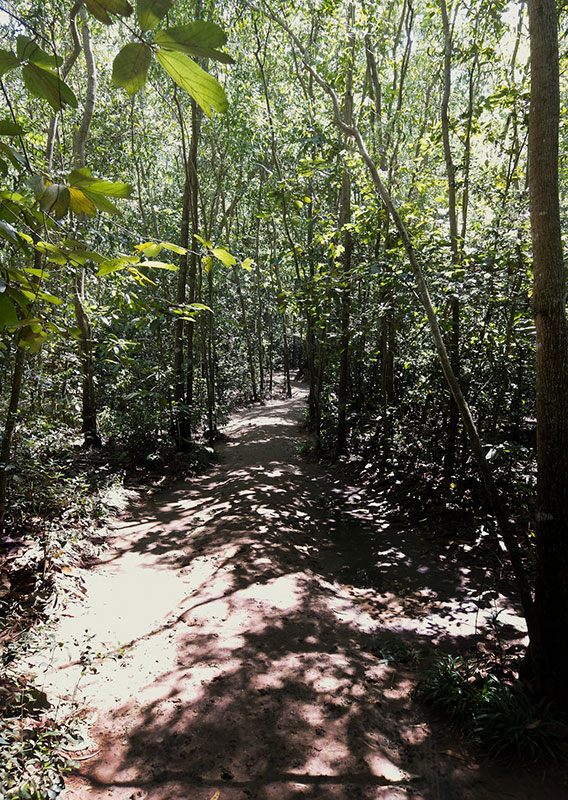
Above the Cui Chi Tunnels
While in Ho Chi Minh City, I wanted to see some of the affects of the Vietnam War. I was really curious to hear the Vietnamese side of the story. My three travel companions and I traveled to and toured the Cu Chi Tunnels, which are about 70 km from the city. We struggled to understand the tour guide, his pronunciation of English sometimes missed important consonants. Several tourists on the bus carried on their own loud conversation which added to the difficulty of hearing and understanding.
I’ve been fairly good at contextual interpretation ever since working at the multinational-employed Industrial Light and Magic. My late night phone calls to artists in my early days there transformed my Tennessee drawl into an enunciating and succinct speech. The main goal was to communicate effectively and quickly to minimize disturbance of the artist while they were not at work. I would even sometimes pick up the accents of the people I was talking to. I’m not sure if they took offense, but it seemed to help the communication.
On the bus to the Cui Chi Tunnels, I started to occasionally repeat back what I thought the guide was saying as a question to see if I was understanding it correctly and to help the others around me in case they were having the same difficulty. The guide would correct a word or two or elaborate to help us understand what he was trying to communicate.
Once we got to the tunnels and got into the tour I realized that the ingenuity of the villagers was amazing. From piping away smoke from their cooking fires, to traps made from pits and wood, I really found an appreciation for how the Vietnamese defended their homes.
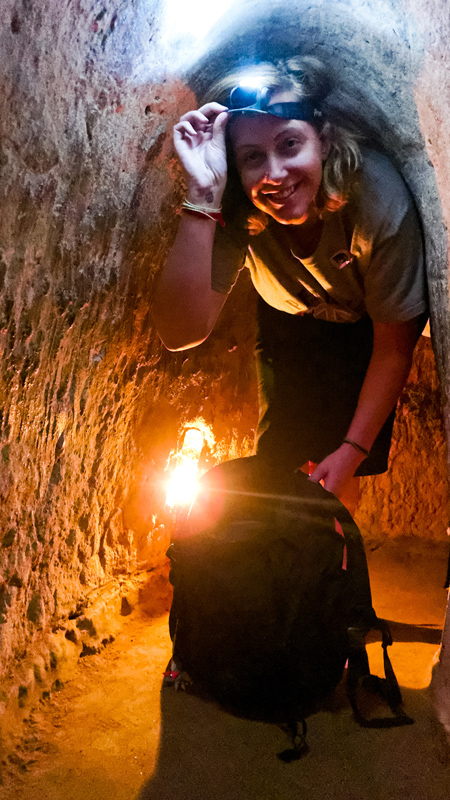
Jessica inside a Tunnel
At one point the guide was describing the “model” tunnels. We didn’t understand. Were these a scale representation of the entire tunnel system he spoke of? What was the purpose of having a model other than to show tourists? After some further discussion and getting him to explain it without the use of the word “model,” we found out that “decoy” was a better word to describe some of these tunnels. They had dead ends and didn’t connect to their main tunnel system.
Crawling through the dark tunnels, combined with the firing range nearby where machine guns and rifles spat sporadically added to an already visceral experience.The tunnels,. At the end of the tour, we watched a propaganda film for the North Vietnamese which really was the most Anti-American film I had ever seen. The US were called criminals and it rallied for the people to fight for their homeland. It was very effective in it’s message. It featured a woman who had killed many Americans and touted her as doing her part for her country.
I split off from my traveling companions after we returned to the city. I wanted to see the War Remnants Museum. Partly because my father had served in the Air Force during the Vietnam War, and partly because I was deep into a screenplay I had been writing and was absorbing what it was like for another side to fight a war.
I went to the museum not really knowing what to expect. I realized that I really didn’t know why the Vietnam War happened or what was involved. I knew the US was there to support the South Vietnamese and that the Viet Cong were the bad guys.
Surrounding the building was the usual collection of airplanes, helicopters, tanks, trucks, and heavy guns. Inside were photographs, newspaper clippings, maps, and stories of the history and effects of the war. The history of occupation by the Chinese, French, and then the US was detailed through the eyes of the Vietnamese. What I thought was an attempt at helping a democracy protect itself from the invading communists seemed to be more about the reunification of a people and culture. It also seemed that all the various countries that were involved with Vietnam were only interested in the minerals that could be mined from the country. The methods of warfare that the US employed, largely the desertification attempt with the chemical “agent orange” were brutal and inhumane. I also found out that this chemical was created by Monsanto, the company currently genetically modifying crops. The effects of this chemical are multi-generational. Not only were the forests dying, the people hiding in them were as well. The ones who didn’t die were genetically modified by their exposure to the chemical. Their children were born physically deformed. Not just the ones who were pregnant at the time, but also the ones who didn’t conceive until much later.
I left the museum with a heavy heart. I now understood the protests of the Vietnam War. I felt ashamed at our country as a whole. I had seen the invasion of Iraq over the WMD’s play out for oil rights. Now I was understanding another of our wars which was supposed to be about protecting democracy and the people, but really was about something that is in the ground. The grass is greener so let’s invade and take the grass? How could anyone from the US feel welcome or comfortable coming to Vietnam?
I walked through the markets pondering these thoughts as people hounded me to buy souvenirs that looked no different from the wares the merchant next to them were hawking.
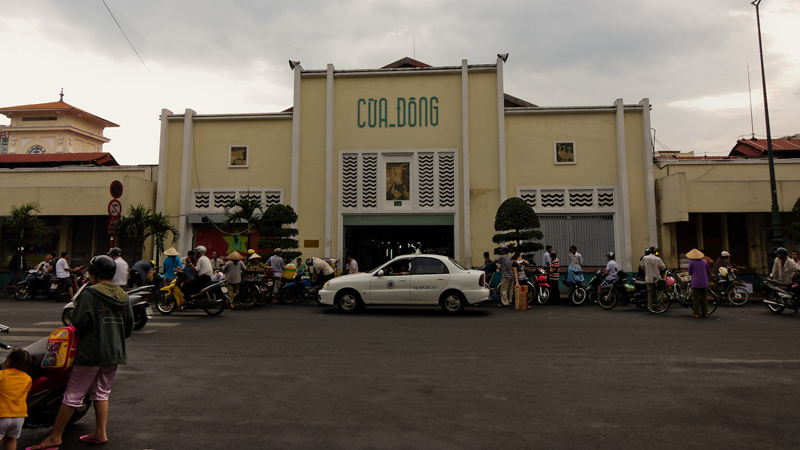
Cua Dong Market
I stopped and got a snickers bar and a carton of milk. I hoped that might soothe my mind. It was hot and humid in Ho Chi Minh City in December and I was wearing a full beard. It was all adding to my uneasiness.
Walking across the street to the park was another special adventure. The scooters, motorbikes, cars, and buses don’t stop in Vietnam. To cross the street, you must literally wade through the traffic. They split and slow down, but nobody ever stops. Once I reached the park, several women laughed and asked what I was eating. I think that since I was drinking milk made them more curious. I thought that was odd that they thought it was odd. I watched several guys kick a hacky sack which looked like a badminton shuttlecock. They were quite happy playing in the park.
As I finished my snack, which did improve my spirits considerably, I was stopped by a group of four students. They were taking a survey for their university class. I happily answered their questions. They needed a photograph as proof for their class, and I got a photo of them as well. I felt like there could be more to say, but they wanted to move on. They needed more people for their survey. One student, who introduced himself as Minh, asked if he could talk with me further.
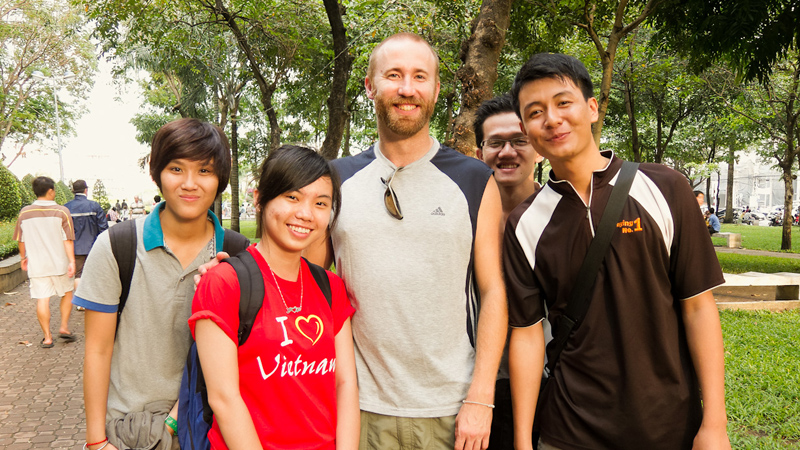
Surveyors and me
We sat down and started talking. Basic small talk first: where did we live, where did we grow up, what I was doing in the city, what was he, and so forth. As time passed we got deeper and deeper into conversation and I was really enjoying it. One of the questions that everyone wanted to know was if anyone ate dog meat. So I asked. It seemed that this wasn’t a common dietary item from his answer.
Over the course of the next hour, Minh’s friends walked by and started to join us. We talked about pop culture, where clothing was made in the city, our hopes and dreams, favorite restaurants, my future travel plans, and where I had been already. They asked questions about how to say certain things, and asked of some phrases they had learned were correct. At times I felt like I was the character Adrian Cronauer, played by Robin Williams, teaching Vietnamese students in “Good Morning Vietnam.” We laughed and truly enjoyed each other’s company and conversation. We also got into some heavier topics like the war and their view of Americans, which was very much on the forefront of my mind. They didn’t have any resentment, only warm feelings and aspirations. I probed deeper to find out if there families felt the same. They seemed to feel that their parents shared similar views and were quite content with how things turned out. I know this was a small scientific sampling, but they felt that all of their peers shared their view as well.
I had learned that North Face and several hat makers and other clothing companies have factories here. The medium sized $20 North Face jacket proved to be as elusive as air conditioning in Ho Chi Minh City. It feels like the Vietnamese economy is doing well. I soon had to leave to rejoin my traveling companions for dinner so we wrapped up the conversation club after over two hours in the park. We had another picture with the new group and exchanged some email addresses.
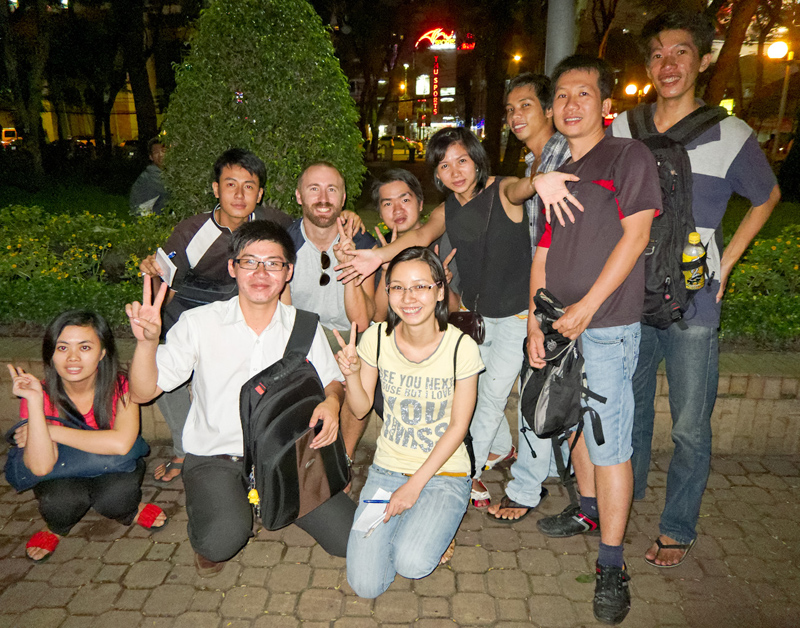
Conversation club
Fast forward 5 months, and I’m now on a flight to New Zealand. The only thing I know is that I’d like to get a tattoo and I don’t think the language will be a barrier.
Then I hear the flight attendant say “rippa” in a classic Aussie accent. A smile spreads across my face as I realize I will have to learn a whole new language: British.
It’s time for a conversation with the Kiwi’s…